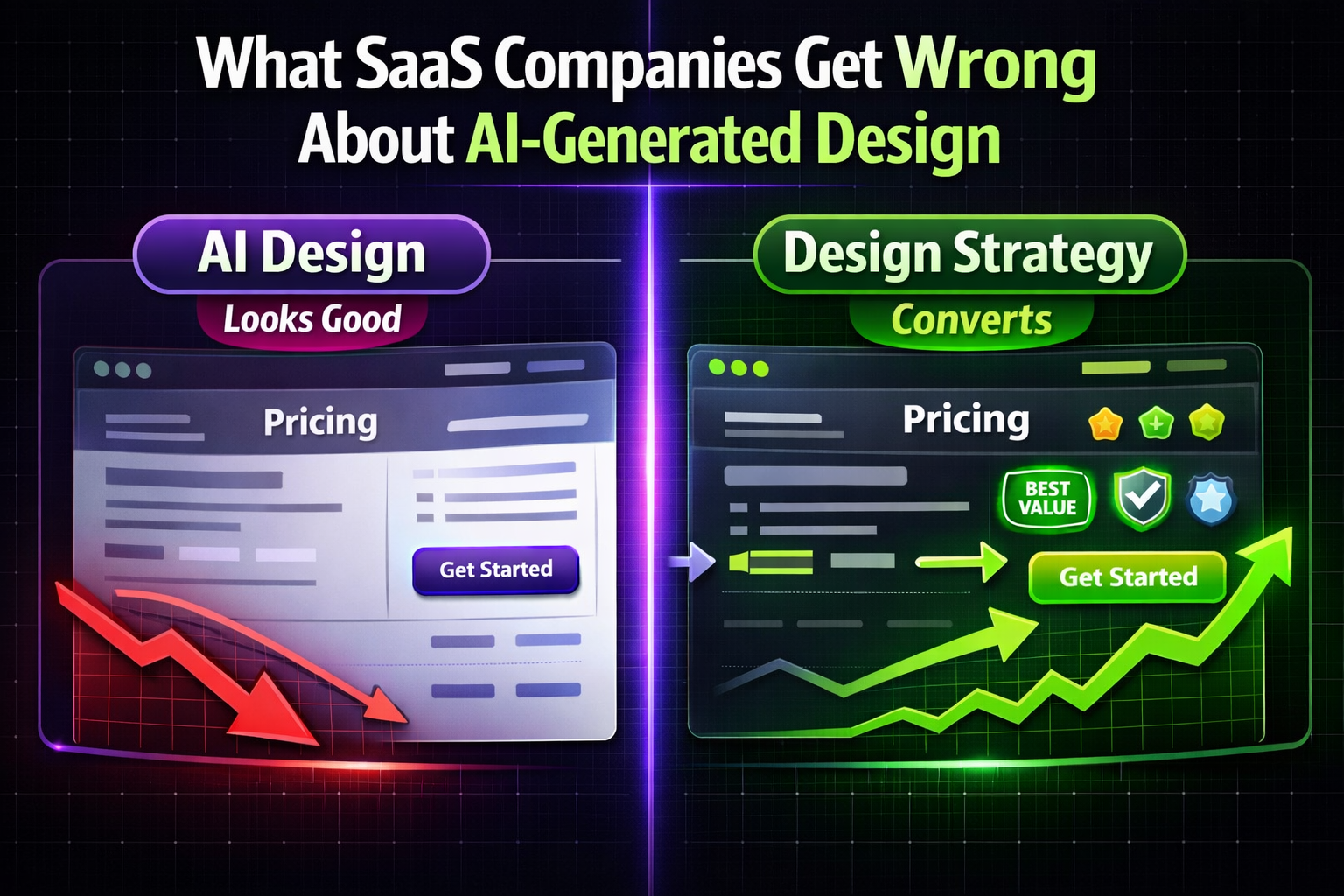
What SaaS Companies Get Wrong About AI-Generated Design

Author
What SaaS Companies Get Wrong About AI-Generated Design

Introduction

There is a moment most SaaS teams recognize. The homepage starts to feel outdated, the pricing page is not converting as expected, and the sales deck no longer reflects the product’s value. At the same time, the design backlog continues to grow across multiple sprints.

In response, many teams turn to AI design tools. Prompts are entered, visuals are generated, and the results look clean and modern. This often leads to a critical internal question about whether traditional design resources are still necessary.

What appears to be a cost discussion is, in reality, a design strategy issue.
When Better Design Delivers Worse Results

Once AI-generated visuals are deployed, the immediate impact is usually positive in appearance. Pages feel more consistent, layouts look refined, and the overall brand presentation improves.

However, performance metrics often reveal a different outcome. Conversion rates remain flat or decline. Pricing pages underperform, demo requests drop, and even well-designed emails fail to engage as expected.

The key observation is simple. Visual quality improves, but business outcomes do not.

The Core Misunderstanding

The issue is not the capability of AI design tools. These tools are effective at generating layouts, components, and visual systems quickly. The efficiency gains are real and valuable.

The mistake lies in confusing visual production with design thinking.

AI tools generate what a page should look like based on patterns. They do not determine what that page should achieve. They do not decide which elements should drive action, how friction should be managed, or how trust should be established at critical decision points.

These are strategic decisions, not visual ones.

Design Is Not Just Aesthetic

In a B2B SaaS environment, every major page in the funnel performs a specific role. These roles extend beyond presentation and directly influence user behavior.

  • A homepage segments users based on intent and awareness
  • A pricing page shapes decision-making and reduces hesitation
  • A feature page addresses objections and reinforces value
  • A demo request form builds trust at the final conversion stage

Each of these requires deliberate design decisions grounded in user psychology and business context. AI tools do not inherently provide this layer of intent.

Where AI Design Works Best

AI-generated design has a clear and valuable role when used in the right context. It performs well in areas where speed and consistency matter more than strategic depth.

These include:

  • Social media graphics and marketing visuals
  • Blog illustrations and featured images
  • Email headers and lightweight campaign assets
  • Internal presentations and supporting collateral

In these cases, design supports communication rather than driving conversion. AI tools can significantly improve efficiency without introducing risk.

Where Strategy Must Come First

There are specific areas where design directly impacts revenue and user behavior. In these cases, relying solely on AI-generated output can lead to underperformance.

Critical touchpoints include homepages, pricing pages, onboarding flows, and sales materials. These require a clear understanding of user intent, friction points, and conversion pathways before any visual decisions are made.

AI can assist in execution, but it should not define the structure or strategy of these experiences.

The Missing Step Most Teams Skip

Teams that successfully integrate AI into their design workflows treat its output as a starting point rather than a final solution.

They review generated designs with a strategic lens, asking key questions:

  • Is attention being directed to the right elements?
  • Are trust signals clearly visible and effective?
  • Does the layout reduce or introduce friction?
  • Is the call to action positioned for maximum impact?

This review layer is often missing. Without it, even polished designs can fail to perform.

Closing the Gap Between Output and Impact

For SaaS teams adopting AI design tools, the real requirement is not just better execution but stronger strategic oversight. The gap is not filled by tools alone, nor by purely aesthetic design expertise.

It requires the ability to evaluate design decisions based on their impact on conversion before those decisions are implemented.

This is what separates design that looks correct from design that performs effectively.

A Practical Way Forward

If this capability is not fully developed in-house, working with a design partner can provide both strategic direction and execution support.

Payan works with B2B SaaS teams as an embedded, asynchronous design partner without long-term commitments. The focus remains on strategy-first design that aligns visual output with measurable business outcomes.

For teams looking to ensure that design decisions contribute directly to growth, this approach offers a structured and reliable path forward.

Simple, ongoing design
support for fast-moving
teams.

Ongoing design requests, handled with predictable turnaround. No long-term commitment.

How This AI Brand Got the Upgrade It Deserved →
Interactive Design Preview