Should Your SaaS Team Use Vibe Design or Hire a Design Partner?

Author
Should Your SaaS Team Use Vibe Design or Hire a Design Partner?

Introduction

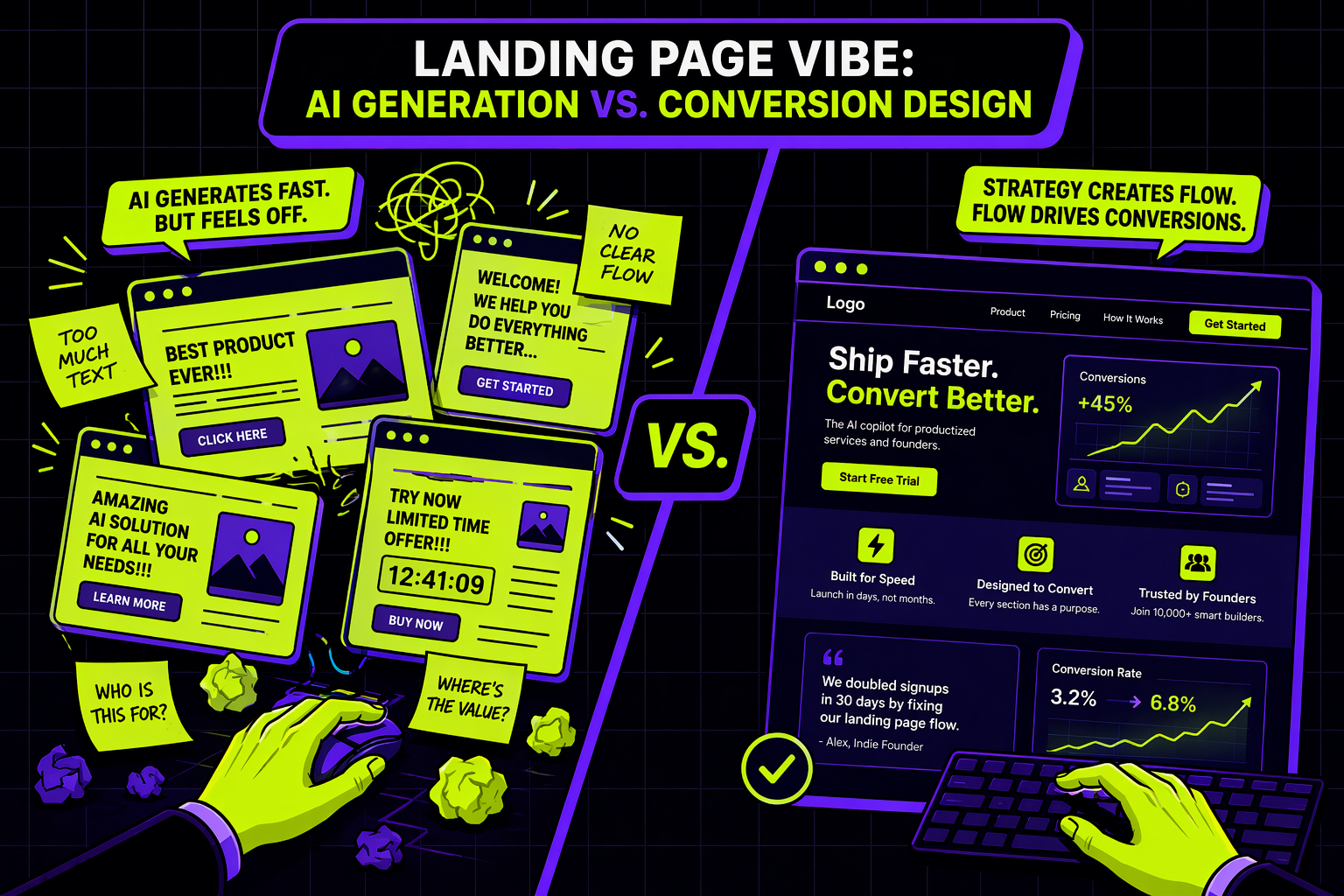
A common question in SaaS teams today is whether a design partner is still necessary or if AI-driven “vibe design” can replace it. AI-assisted design tools have improved significantly. Teams can describe a UI, generate realistic outputs, and ship quickly. For resource-constrained startups, this capability is valuable.

However, speed alone does not guarantee effectiveness. Fast design and effective design serve different purposes. Confusing the two can reduce conversion, trust, and pipeline performance.
What vibe design is and what it is not

Vibe design refers to using natural language prompts and AI tools to generate UI quickly. It relies on rapid iteration and intuition rather than structured design systems or formal UX processes.

It reduces the time between idea and visual output. This is useful, but it does not replace strategic thinking. A visually polished screen is not equivalent to a high-converting signup flow. A clean homepage does not ensure an effective pricing page. In B2B SaaS, design functions as decision architecture. It determines what users see, what they trust, and what actions they take.

Vibe design does not address these structural decisions. It accelerates execution but does not validate outcomes.

Where vibe design adds value

Vibe design is effective in specific scenarios:

  • Early-stage exploration and ideation
  • Rapid prototyping for internal reviews
  • Visualizing concepts for alignment across teams

It is also useful when a strong design system already exists. With defined components, spacing rules, and UX patterns, vibe design can operate within clear constraints. In this context, it becomes a tool for faster execution rather than an unstructured process.

The distinction is important. Vibe design within a structured system supports efficiency. Vibe design as the primary process introduces inconsistency and long-term complexity.

Where it breaks down for Series A+ SaaS

As companies move beyond product-market fit, the cost of ineffective design increases.

At this stage, design directly impacts revenue:

  • Pricing pages must clearly qualify buyers
  • Onboarding flows must guide users to value quickly
  • Websites must establish trust and credibility

A visually acceptable design that lacks clarity or structure can reduce conversions, increase churn, and extend sales cycles.

Over time, reliance on generated outputs without a cohesive system leads to fragmentation. Inconsistencies accumulate across product and marketing surfaces. Maintenance becomes more complex, and design efforts shift from improvement to correction.

What a design partner solves

A design partner provides structure, continuity, and strategic alignment.

Their role extends beyond visual execution. They translate go-to-market strategy into design decisions. This includes:

  • Aligning website messaging with buyer expectations
  • Structuring pricing pages as qualification tools
  • Ensuring onboarding flows deliver on sales promises

A design partner focuses on user psychology and decision-making, not just aesthetics. For Series A+ SaaS companies, the most effective model is not a traditional agency or a freelance arrangement. It is a partnership that integrates with internal workflows, operates asynchronously, and delivers senior-level execution without the overhead of full-time hiring.

Payan follows this model, offering a subscription-based approach that integrates design directly into GTM processes.

A practical framework for decision-making

The choice depends on the role design plays in your business.

Vibe design is suitable when:

  • You are pre-product-market fit and optimizing for rapid learning
  • You have an established design system and need faster execution
  • Outputs are internal and not exposed to customers

A design partner is more appropriate when:

  • Design directly impacts customer-facing conversion
  • Trust signals influence sales outcomes
  • Consistency across multiple touchpoints is required
  • Current design efforts produce visuals without measurable business results

Most Series A+ SaaS companies fall into the second category. Many continue to rely on vibe design tools because they are accessible and fast, even when they are not sufficient.

The real question

The decision is not strictly between vibe design and a design partner.

The more relevant question is whether your current design approach supports your business objectives. AI-driven tools can accelerate execution. They do not replace strategic decision-making. If design is expected to guide buyers through decisions, establish trust, and drive conversions, it requires intentional structure and expertise.

That is the role of a design partner.

If your team is evaluating how design fits into your GTM motion, a subscription-based design partner model can provide the required balance of speed, consistency, and strategic alignment.


If you're a SaaS team trying to figure out where design fits in your GTM motion, Payan works as a subscription design partner for B2B SaaS companies at Series A and beyond, senior-led, async, no long-term contracts.

Simple, ongoing design
support for fast-moving
teams.

Ongoing design requests, handled with predictable turnaround. No long-term commitment.

How This AI Brand Got the Upgrade It Deserved →
Interactive Design Preview