Most SaaS companies do not decide to overload their designer. It happens gradually, and it looks reasonable at every step.
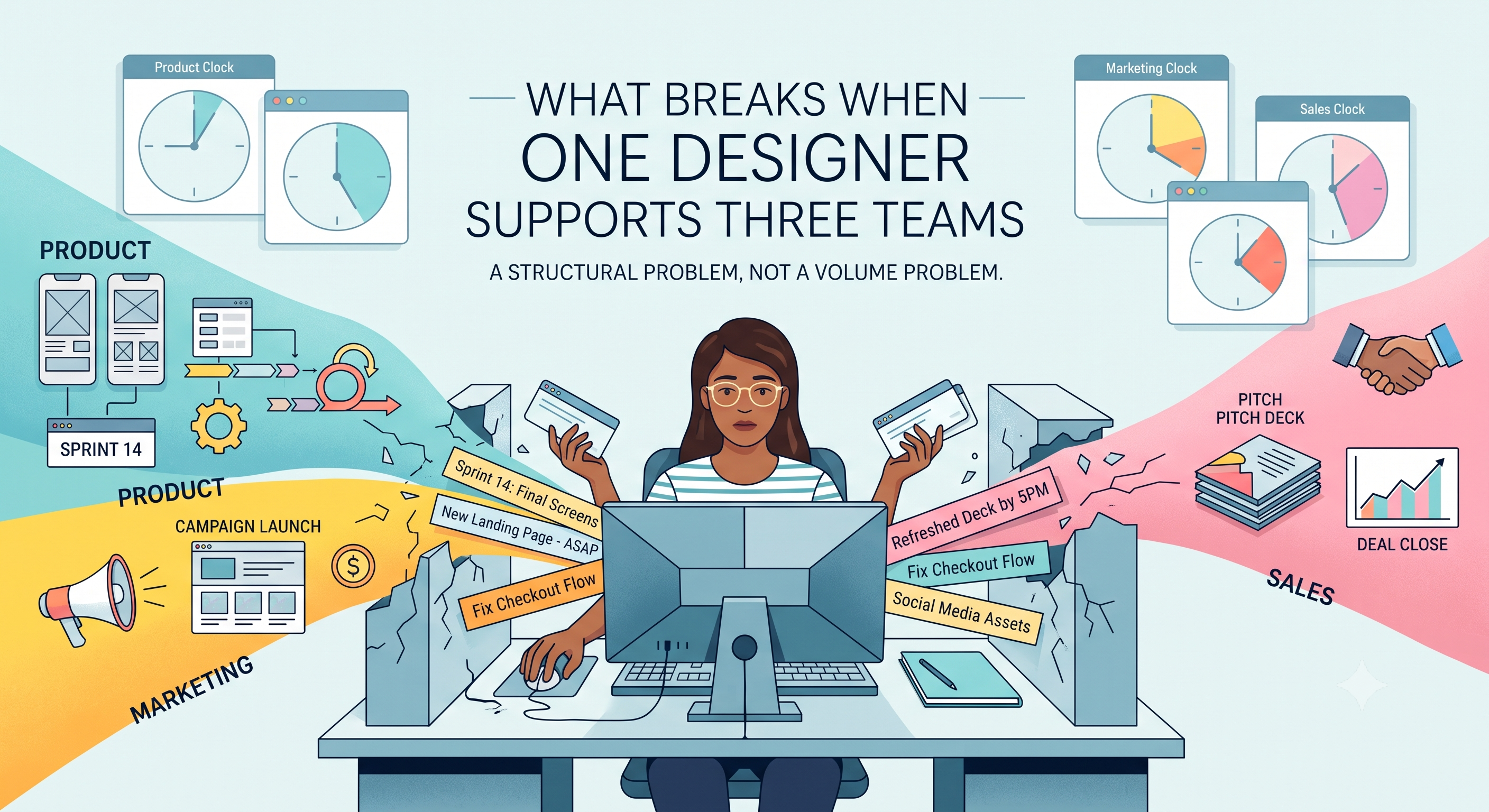
You hire one designer. At first they sit with product. Then marketing needs a landing page for a campaign, and it makes sense to ask the person who already knows the brand. Then sales needs a deck refreshed before a big pitch, and that also makes sense. Within two quarters, one person is supporting product, marketing, and sales, and nobody has formally acknowledged that this happened.
On paper the setup looks efficient. One designer, full visibility across the company, consistent brand execution everywhere. In practice, something starts breaking. It is usually not obvious at first, and it is rarely the thing leadership expects.
The problem is not volume. It is arrival pattern.
If design requests arrived at a steady rate, one designer could absorb a lot. That is not how it works.
Product runs on sprint cycles. Marketing runs on campaign dates. Sales runs on whatever deal is closing this week. These three clocks do not align, and none of them are aware of the others. A sprint deadline and a campaign launch and an urgent pitch deck can land in the same forty-eight hours, and each requester genuinely believes theirs is the priority.
So the designer becomes the person who has to arbitrate between three teams who all outrank them in the conversation. That is not a design problem. It is a structural one, and it produces predictable damage.
What actually breaks first: prioritization becomes political
When three teams share one designer with no shared queue, the work does not get prioritized by impact. It gets prioritized by proximity and urgency.
The loudest requester wins. The person who caught the designer in the hallway wins. The request framed as an emergency wins, whether or not it is one. Over time the designer learns that responding fast is safer than pushing back, because pushing back means three separate conversations about why their team is not the priority.
This is the point where design stops being a decision-making function and becomes a service desk. The shift is quiet. There is no meeting where it is announced. But once it happens, the designer's judgment stops being the input, and the request queue becomes the input instead.
Then discovery disappears
Good design work starts before the file is opened. Someone has to ask why this page exists, who is landing on it, what objection it needs to remove, and what happens if the visitor does not convert. That work takes time, and it is invisible.
When one person is absorbing requests from three directions, discovery is the first thing that gets cut. Not because anyone decides to cut it, but because it is the only part of the process nobody is measuring. Nobody notices a missing discovery conversation. Everybody notices a missing deliverable.
The result is a designer executing briefs they had no part in shaping. Marketing writes the copy, decides the structure, and asks for design. Product specs the flow and asks for screens. Sales sends a slide outline and asks for polish. The designer builds what was asked for, and the work is competent, and it still does not move anything. This is the same pattern that shows up in most underperforming SaaS landing pages, where the problem is not the visual layer but the decision layer underneath it.
Quality drifts across surfaces before it drops on any single one
The next thing to break is consistency, and it breaks in a way that is easy to miss.
Each individual deliverable still looks fine. The product screen is clean. The landing page is clean. The sales deck is clean. But they start to feel like they came from three different companies, because they were made in three different mental contexts, weeks apart, under three different deadlines.
A buyer does not experience your design surface by surface. They see an ad, land on a page, book a demo, sit through a deck, and start a trial. If the story shifts between those moments, confidence leaks. The visual system can be intact while the narrative system falls apart. This is the difference between interface quality and experience quality, and it is exactly the distinction that determines whether a buyer builds enough confidence to move forward.
One designer under load will protect visual consistency, because that is what gets noticed in review. Narrative consistency is what quietly erodes.
The design system stops being maintained
Systems are maintenance work. Components need to be updated, documented, deprecated, and reconciled when three teams push in different directions.
Maintenance is never urgent. It never has a deadline attached to it. So when the queue is full, it does not get done.
Six months in, the component library has three versions of the same button, the marketing site has drifted from the product UI, and every new request takes longer than the last one because the foundation underneath it is inconsistent. The designer is now slower, and the slowness looks like a performance problem rather than what it actually is, which is accumulated debt that nobody gave them time to pay down.
The strategic work never happens
This is the most expensive breakage and the hardest one to see, because you cannot point at anything that went wrong.
You hired a designer with judgment. You wanted someone who could look at your pricing page and tell you it is attracting the wrong buyers. Someone who could restructure your homepage narrative when the product changed. Someone who could run a proper audit and tell you where the evaluation journey breaks.
None of that fits in the gaps between three teams' requests. Strategic work requires uninterrupted context, and context switching between product, marketing, and sales destroys exactly that. So the designer does execution well and never gets to the work you actually hired them for.
Nobody complains, because the deliverables are shipping. The cost is entirely invisible until you look at conversion numbers that have not moved in three quarters.
Then the designer leaves
People do not usually leave because of workload. They leave because the work stopped being interesting.
A designer who spends a year taking requests from three teams, with no discovery, no system ownership, and no strategic input, is not doing the job they signed up for. They are doing production. Production is fine work, but it is not why a senior designer joined a company at Series A.
When they leave, they take all the undocumented context with them. Every decision they made and never wrote down, every reason a component works the way it does, every piece of institutional knowledge about your buyer. The replacement starts from zero, and the first six months are spent rebuilding what already existed inside one person's head.
The reframe: this is not a headcount problem
The instinct at this point is to hire a second designer. Sometimes that is correct. Often it is not, and it just distributes the same structural problem across two people.
The more useful question is not how many designers you need. It is which parts of this workload require judgment and which parts require capacity.
Judgment work is deciding what should be built. It is positioning, page structure, buyer psychology, conversion architecture, and the choices that determine whether a page works. This work needs deep context and uninterrupted time, and it belongs with someone who is inside your business.
Capacity work is building what has already been decided. Campaign pages, feature graphics, deck refreshes, iteration on an established system. This work needs reliability and turnaround, not company context.
Most overloaded in-house designers are drowning in capacity work while their judgment work goes undone. Hiring a second person who also splits across three teams does not fix that. It just means two people are now doing shallow work instead of one.
What to do instead
Start by separating the queues. Product, marketing, and sales should not be submitting into the same undifferentiated pile with the same implied urgency. Even a simple shared intake, where each team's requests are visible to the others, changes the politics of prioritization immediately.
Then protect the judgment work explicitly. Block it. Name it. Treat a positioning review or a conversion audit as a deliverable with a deadline, not as something that happens when things calm down. Things will not calm down.
Then move the capacity work somewhere it does not compete for the same hours. This is where an external design partner earns its place, not as a replacement for your designer, but as the layer that absorbs execution volume so your in-house person can do the work only they can do. Your designer knows your product, your buyer, and your internal politics. That knowledge is wasted on the fourth version of a webinar graphic.
The teams that get this right do not have more designers. They have a clearer split between deciding and building, and they stop asking one person to do both across three departments with three different clocks.