Every campaign has a moment where it just... stalls. The strategy is locked, the copy is approved, the launch date is set. And then everyone waits on design.
If that sounds familiar, you already know the problem. What most teams don't have is a plan to actually fix it.
The instinct is usually to push harder. Chase the designer for a faster turnaround. Add the request to three different Slack channels. Escalate to the manager. None of that fixes the bottleneck — it just makes the wait feel more urgent while the underlying capacity problem stays exactly the same.
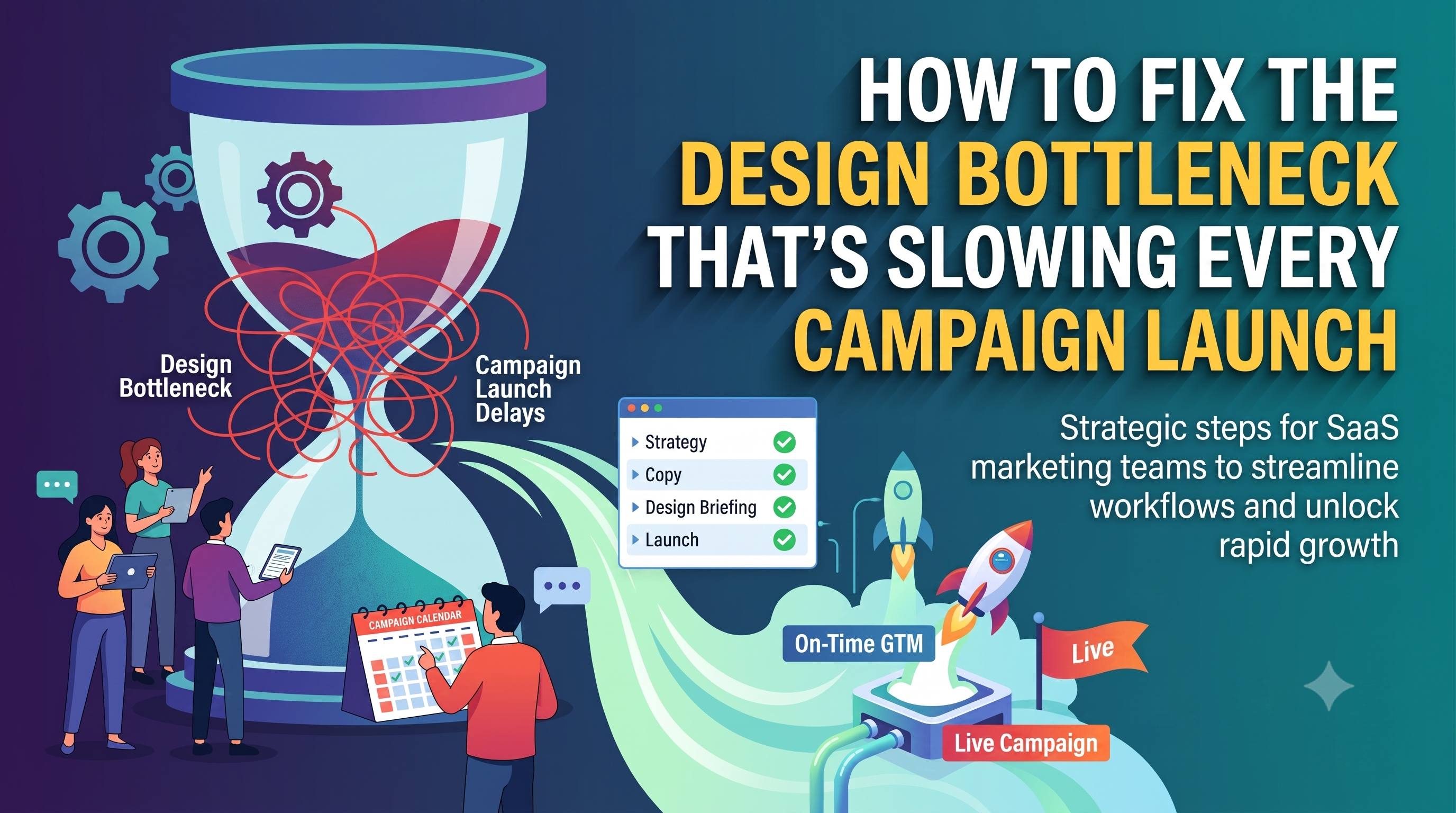
The real fix starts with understanding why design becomes the chokepoint in the first place. It's rarely about individual speed. It's about sequencing. Design is almost always the last step before launch, which means every delay upstream — a late brief, a changed headline, an unclear brand guideline — lands on design's desk as a compressed deadline. The designer isn't slow. The runway they were given was short.
So the first fix isn't a design fix at all. It's a briefing fix. Campaigns move faster when design is looped in at the strategy stage, not after the messaging is finalized. Even a rough brief two weeks before launch gives a designer room to ask questions, flag risks, and start early exploration — instead of receiving a fully-baked request three days before go-live.
The second fix is capacity, not effort. Most in-house design teams are sized for steady-state work, not launch spikes. When five campaigns converge in the same month, the queue backs up no matter how skilled the team is. This is where a lot of marketing leaders quietly accept slower launches as the cost of doing business. It doesn't have to be. Teams that build in flexible capacity — whether that's a subscription design partner, an on-call freelancer, or a cross-trained internal resource — absorb the spike without the whole campaign calendar shifting.
The third fix is clarity on what actually needs custom design versus what doesn't. Not every asset needs to be built from scratch. Templated systems for recurring formats — social graphics, email headers, one-pagers — free up design hours for the assets that genuinely move the needle, like the landing page or the hero campaign visual. Teams that map this out ahead of time stop treating every request as equally urgent, which is often what causes the queue to jam in the first place.
The fourth fix is ownership. Someone on the team — usually the Head of Marketing or a GTM lead — needs to own the design queue the same way they'd own a sales pipeline. That means visibility into what's in progress, what's blocked, and what's coming next. Without a single owner, requests get duplicated, priorities get reshuffled mid-sprint, and the same asset gets reworked twice because two people briefed it differently.
None of these fixes require a bigger team. They require a different relationship with design — one where it's built into the campaign timeline from day one, not bolted on at the end.
This is exactly the gap a design subscription partner is built to close. Instead of scaling headcount for launch spikes, teams get senior design capacity that flexes with the calendar, plugs into the brief early, and treats campaign design as a GTM function — not a queue to wait on.