Design Subscription vs Freelancer: What SaaS Teams Actually Choose

Author
Design Subscription vs Freelancer: What SaaS Teams Actually Choose

Introduction

SaaS teams choose design models right at the time they have a problem and they need it fixed fast. The first obvious answer is a quality freelancer with experience, a good rate, and can pick up your work as soon as the call ends. 

But that’s when the model works. When the freelancer is backed up with other projects, or they’re out of town for a while, you either have to wait until they’re back, or risk finding someone else again and getting them up to date all over again. 

Here, SaaS teams re-evaluate their requirement, about whether there’s a better way to manage design support. 


What's Covered

  • Why the freelancer model breaks down for SaaS teams
  • The real difference between the two models
  • Side-by-side comparison
  • When each model actually makes sense

Why the Freelancer Model Breaks Down

Freelancers are tuned for projects, which SaaS design isn’t. Projects are bounded design requirements over a short period of time, but SaaS is continuous, working across product, marketing, and sales simultaneously, with varying and shifting priorities. 

Look at some failure reasons that SaaS teams deal with when working with freelancers. 

Availability

Good freelancers are consistently busy, but that also means they’re not available to your timeline, a product launch, campaign push, or sales cycle that needs new collateral. Either you wait for them, compromise in quality with others. You could build a roster of freelancers, but that’s akin to managing an in-house team, and comes with its own unique challenges. 

Context

Every time you bring in a new freelancer, or even someone who is coming back to work with you, you have to explain the product, brand guidelines, marketing cycle, all over again. While that briefing cost is often unseen on individual projects, it can compound when you’re working with multiple freelancers across multiple functions. 

Consistency

Design consistency is more than colors and fonts, but visual logic and information structure. Having multiple freelancers apply their individual perspectives can lead to fracture in the overall design logic. Different pages can have a different feel, and not a coherent showcase of your product.

Find the Pattern

If your team is writing long briefs, checking in, correcting outputs, check the overhead for managing your freelancers. It’s about understanding whether the freelancer structure is working for your business. 

Freelancers optimize for task completion, whereas a design subscription is for continuous output over sustained periods of time. That distinction creates a difference in the output. Reactive design responds to set priorities. But Structural design is built into the core ethos of the product, so the design is consistent across designers, across teams and priorities. 

Engagement Model

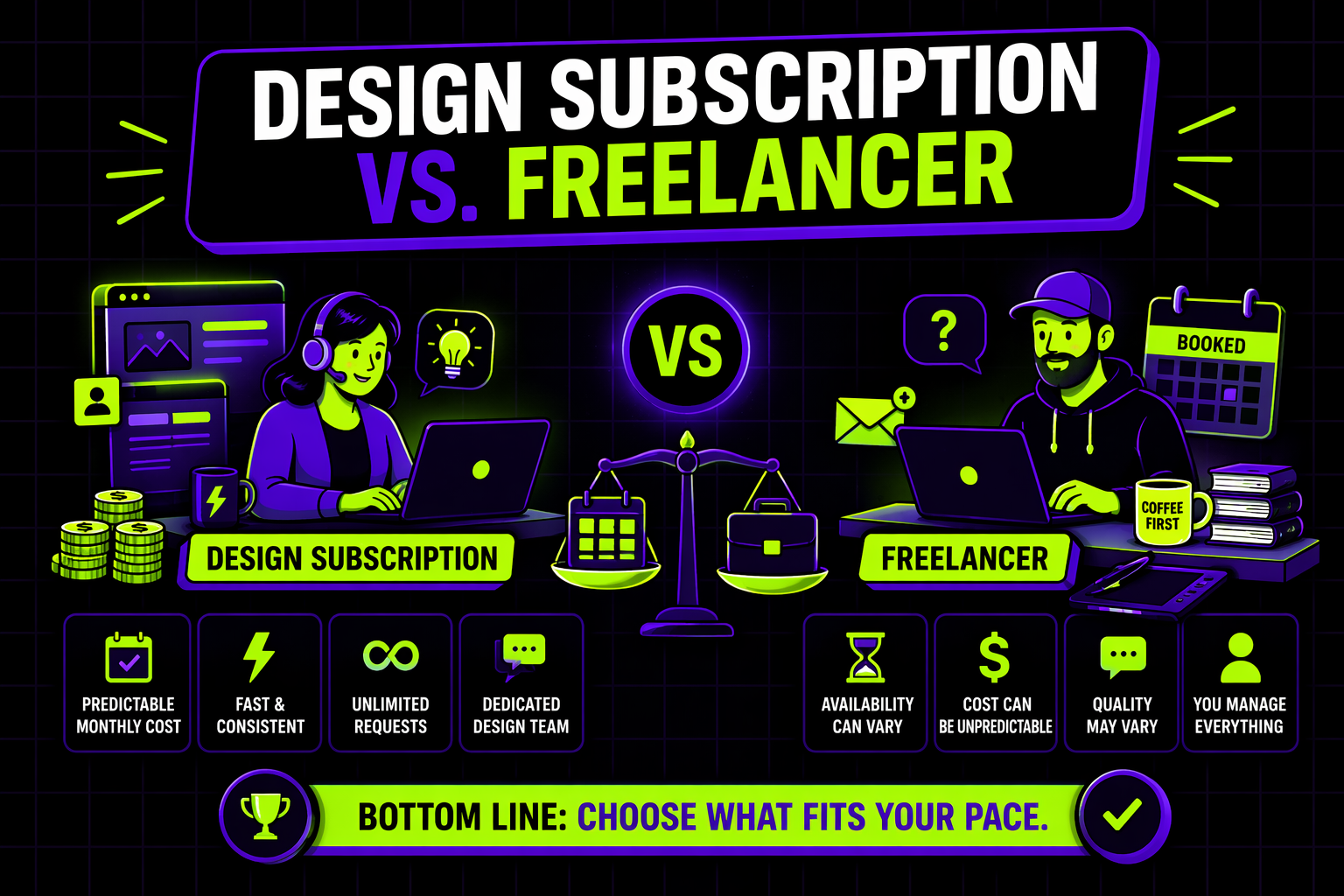
  • Freelancer: Project-based — scoped, delivered, then ends
  • Design Subscription: Ongoing — continuous request queue with no defined end

Availability

  • Freelancer: Depends on their schedule and other clients
  • Design Subscription: Consistent availability, especially during priority spikes

Context Over Time

  • Freelancer: Context resets with each engagement or new person
  • Design Subscription: Builds over time — partner understands product and positioning

Cost Structure

  • Freelancer: Variable — per project or day rate
  • Design Subscription: Predictable — fixed monthly fee regardless of volume

Brand Consistency

  • Freelancer: Varies across different designers and engagements
  • Design Subscription: Maintained — consistent visual and structural logic

Scope Flexibility

  • Freelancer: Limited — typically one person with a specific skill set
  • Design Subscription: Broader — supports UX, marketing, product, and sales assets

Management Overhead

  • Freelancer: Higher — requires briefing, follow-ups, and coordination
  • Design Subscription: Lower — structured workflow with minimal coordination

Strategic Input

  • Freelancer: Varies depending on individual expertise
  • Design Subscription: Built-in — work is aligned to outcomes, not just tasks

Best For

  • Freelancer:One-time projects
  • Clearly defined tasks
  • Short-term needs
  • Design Subscription:Ongoing design needs
  • Cross-functional teams
  • Scaling SaaS environments 


When Each Model Actually Makes Sense

The answer depends on what you need. Design subscriptions aren’t universally the solution. Freelancers can be the right choice in specific situations, but you need to be clear on what those situations are. 

Freelancers make sense when

  • You have a single, well-scoped project with a clear brief. 
  • You need a very specific skill for a limited period of time.
  • You're pre-revenue and managing cash flow carefully. 
  • Design is occasional, maybe few times a year
  • You have an in-house team and just need a specialist

Subscription makes more sense when

  • Design requests come from multiple teams simultaneously
  • You faced availability issues with freelancers
  • You're spending more time managing design
  • Brand and visual consistency is fragmenting
  • You're scaling GTM and design needs to keep pace

You can find out which you need when you look at how your team approaches design. If your team says “We need someone to do X”, that’s a specific task that is better suited for a freelancer. But if your team is saying “Our current design philosophy isn’t working for the whole organization”, then that’s your signal the  model is bottlenecking you. 

Also look at how much time your team spends managing design work versus actually using itThe coordination costs can add up and become a major friction point later on. 

A question worth sitting on

How many hours did your team spend last quarter managing freelancers, briefs, responses, reviews, revisions, or searching for someone new? If that number is more than a blip on the radar, then count it as a tangible cost. 

What About Cost?

The common assumption is freelancers are cheaper than subscriptions. That's often true on a per-project basis. But over a longer period of engagement, especially with briefing time, revision rounds, and coordination overhead involved, potential delays during projects and quality inconsistency, that can add up. 

A subscription model moves the cost from variable and unpredictable to fixed and predictable. If your team can plan your design needs around each month, then the predictability can save a lot more money than hiring a team of freelancers. 

Hybrid Options

Some teams handle 80% of their design needs with a subscription, with a specialist freelancer for things that could be very specific. This gets them the structural benefits of a subscription while getting flexibility for unique requirements when needed. 

Still Evaluating Freelancers, But Need More?

Payan works with SaaS and B2B teams as an ongoing design subscription partner, covering UX, product marketing, website pages, and sales enablement under one predictable monthly engagement.

If managing freelancers is costing your team more than it should, a 20-minute conversation to see whether a different model is right for you. No pitch. No pressure. Just a straight conversation about what's creating friction and whether Payan is a fit for you. 

→ Book an intro call with Payan

Simple, ongoing design
support for fast-moving
teams.

Ongoing design requests, handled with predictable turnaround. No long-term commitment.

How This AI Brand Got the Upgrade It Deserved →
Interactive Design Preview