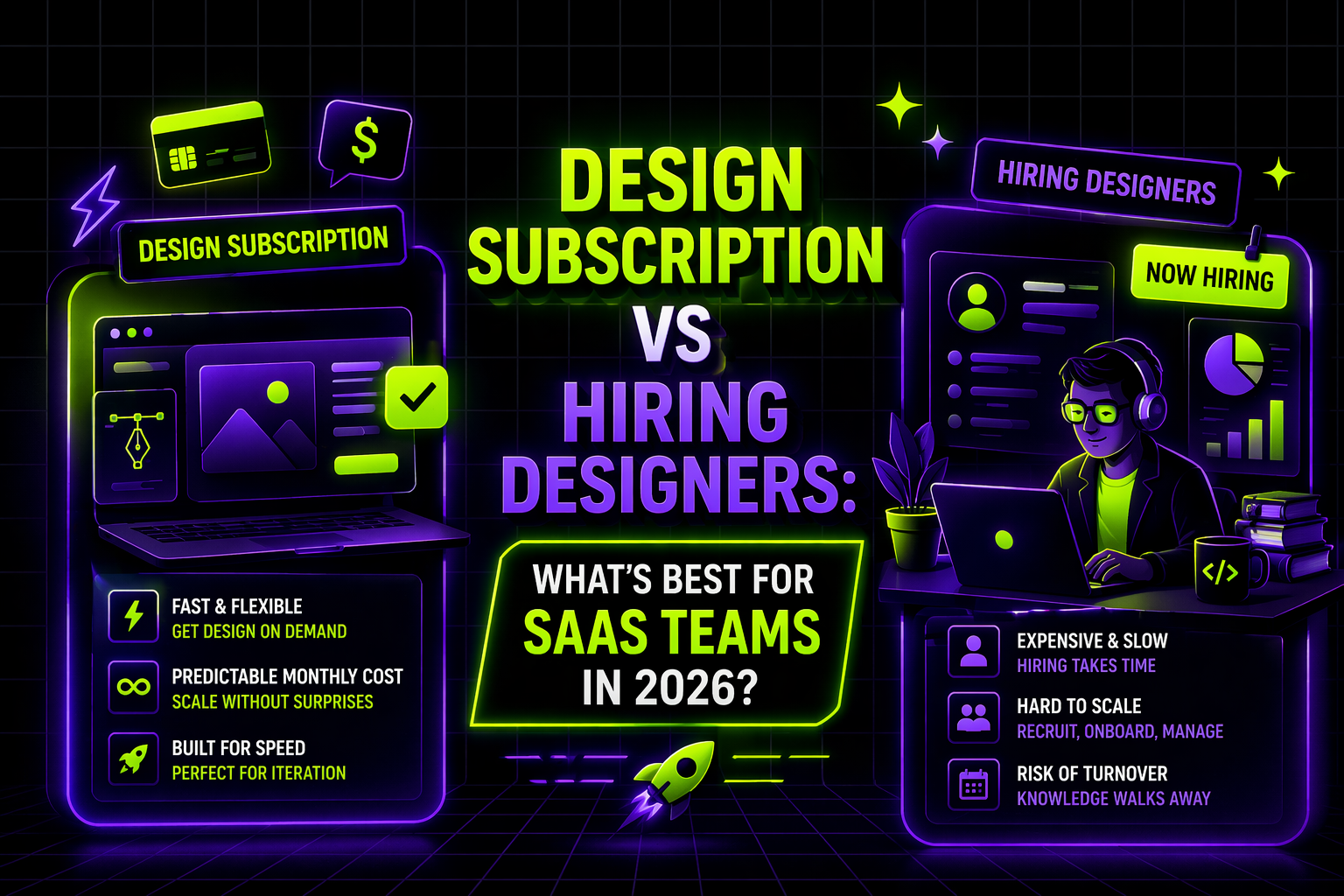
Design Subscription vs Hiring Designers: What’s Best for SaaS Teams in 2026?

Author
Design Subscription vs Hiring Designers: What’s Best for SaaS Teams in 2026?

Introduction

A SaaS team I worked with recently hit a familiar bottleneck.

Their product roadmap was moving fast. Marketing had campaigns lined up. Sales needed updated decks. But every design request—whether it was a landing page tweak, a feature illustration, or a quick UI fix—started slowing things down.

The first instinct was obvious: “Let’s hire a designer.”

But within weeks, new questions emerged.

  • Is there enough consistent work to justify a full-time hire?
  • What happens when priorities shift?
  • How do we support design needs across product, marketing, and sales at the same time?

This is where most SaaS teams pause.

Design is no longer a one-time requirement. It’s an ongoing function that spans:

  • Product experience
  • Growth and conversion
  • Sales enablement
  • Brand consistency

So the real decision is not “Do we need design?”

It’s “What is the most effective way to access design capability?”
What Hiring a Designer Actually Involves

Hiring a designer usually means bringing in a full-time or part-time in-house resource.

What you gain:

  • Dedicated ownership
  • Deep product and domain understanding over time
  • Close collaboration with internal teams

Where it works well:

  • Stable and predictable design workload
  • Product-heavy environments with continuous UX needs
  • Teams that require tight day-to-day collaboration

The hidden complexity

Hiring is not just about salary. It includes:

  • Recruitment time (often 2–8 weeks)
  • Onboarding and ramp-up
  • Continuous management and feedback
  • Fixed monthly cost regardless of workload

For many SaaS companies, especially in early or growth stages, this creates a mismatch.

👉 Design demand is variable, but cost is fixed.

What Is a Design Subscription?

A design subscription is a service model where you pay a fixed monthly fee for ongoing design support.

Instead of hiring internally or outsourcing per project, you:

  • Submit requests through a structured queue
  • Receive continuous design output
  • Scale usage based on business needs

If you're evaluating whether this model fits your stage, you can explore a deeper breakdown on Design subscription for startups.

Typical scope includes:

  • Landing pages
  • SaaS product UI
  • Sales decks and presentations
  • Marketing creatives
  • UX improvements and iterations

Why this model is gaining traction

Because design today is:

  • Cross-functional (product + marketing + sales)
  • Continuous (not one-time)
  • Iterative (requires ongoing refinement)

A subscription model aligns closely with this reality.

Design Subscription vs Hiring Designers: Core Differences

1. Cost Structure

Hiring:

  • Fixed salary and overhead
  • Cost continues even during low workload periods

Subscription:

  • Predictable monthly fee
  • Pay for output and access, not idle time

👉 Subscriptions reduce inefficiency during low-demand cycles.

2. Flexibility

Hiring:

  • Limited to one individual’s capacity
  • Scaling requires additional hiring

Subscription:

  • Flexible request system
  • Ability to handle varied design needs simultaneously

👉 Subscriptions adapt better to changing priorities.

3. Speed of Execution

Hiring:

  • Dependent on one person’s bandwidth
  • Delays during peak workload

Subscription:

  • Structured workflows enable faster turnaround
  • Reduced bottlenecks

👉 Subscriptions improve consistency in delivery speed.

4. Skill Coverage

Hiring:

  • Usually specialized in one area (UI, UX, or branding)
  • Additional needs require freelancers or agencies

Subscription:

  • Broader design coverage within a single model
  • Reduced need for multiple vendors

👉 Subscriptions simplify design operations.

5. Management Overhead

Hiring:

  • Requires active management
  • Performance tracking and feedback loops

Subscription:

  • Managed externally
  • Process-driven delivery

👉 Subscriptions reduce internal coordination effort.

When Hiring a Designer Makes More Sense

Hiring is the right choice when:

  • You have a consistent, full-time design workload
  • Your product requires deep UX ownership
  • You need a designer embedded in daily decision-making
  • You’re building long-term internal design capability

In these scenarios, an in-house designer becomes a strategic asset.

When a Design Subscription Is the Better Choice

A subscription model works better when:

  • Your design needs are variable or unpredictable
  • You need support across multiple functions
  • Speed and flexibility are critical
  • You want to avoid hiring delays and overhead

This is especially relevant for:

  • Early-stage SaaS startups
  • Growth-stage companies scaling GTM
  • Teams running frequent experiments and campaigns

The Hybrid Model (What High-Performing Teams Actually Do)

The reality is—this is not always an either-or decision.

Many high-performing SaaS teams adopt a hybrid approach:

  • In-house designer → owns product and long-term UX
  • Subscription partner → handles execution, marketing, and scaling needs

This creates:

  • Strategic depth internally
  • Execution speed externally

👉 Result: Faster output without overloading internal teams.

A Simple Decision Framework

Before deciding, ask:

  1. Is our design workload consistent or variable?
  2. Do we need ownership or execution speed?
  3. Are we optimizing for cost efficiency or long-term capability?
  4. How many design functions need support?

Your answers will clearly point toward:

  • Hiring
  • Subscription
  • Or a hybrid model

Closing Thought

Design has become a core growth lever in SaaS.

It directly influences:

  • Conversion rates

  • Product adoption

  • Sales effectiveness

  • Brand perception

The question is no longer whether to invest in design.

It’s how to structure that investment in a way that aligns with how your business actually operates.

If your team is experiencing delays in execution, bottlenecks across product or marketing, or difficulty justifying a full-time hire, it may be a signal to rethink your approach.

Payan works with SaaS teams as an ongoing design partner—helping them handle continuous design needs without the friction of hiring or managing multiple vendors.

Simple, ongoing design
support for fast-moving
teams.

Ongoing design requests, handled with predictable turnaround. No long-term commitment.

How This AI Brand Got the Upgrade It Deserved →
Interactive Design Preview