How Heads of Marketing Should Budget for Design in 2026 (Retainer vs. Subscription vs. In-House)

Author
How Heads of Marketing Should Budget for Design in 2026 (Retainer vs. Subscription vs. In-House)

The line item everyone questions

Budget season has a rhythm. Paid spend gets debated but survives, because the dashboard defends it. Tools get trimmed at the edges. And then someone's cursor stops on the design line, and you get the question: "What are we actually getting for this?"

If you're a Head of Marketing at a Series A or B SaaS company, you've probably answered that question with something vague about brand consistency and bandwidth. It didn't feel convincing, because it wasn't framed the way the rest of your budget is framed. Every other line ties to pipeline. Design ties to... output.

That's the real problem to solve in 2026. Not how much to spend on design, but how to structure the spend so it's defensible.
Why the three models keep getting compared wrong

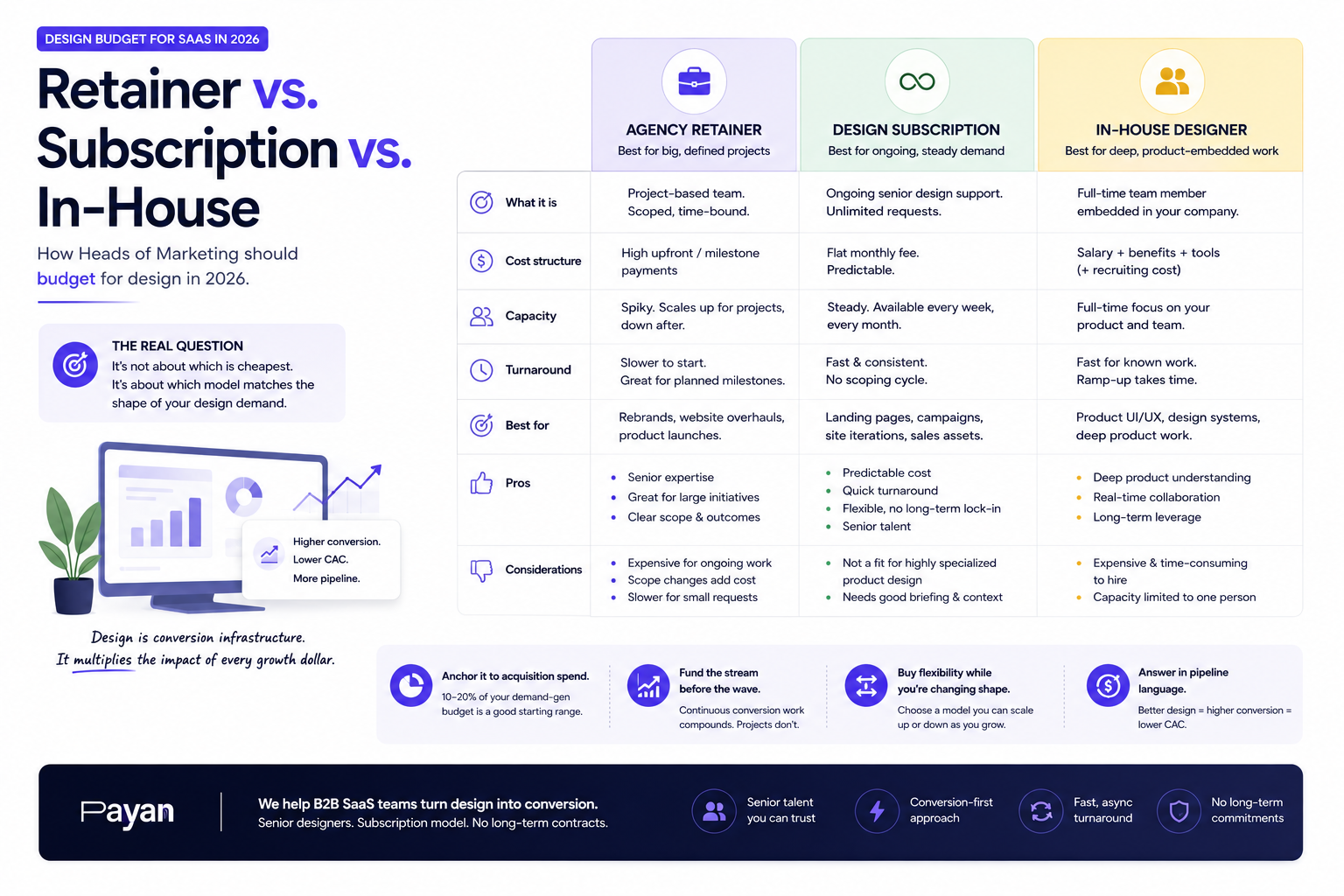
Most budget conversations treat retainer, subscription, and in-house as three prices for the same thing. Cheapest option wins. But they're not three prices for one thing. They're three different answers to what design is for.

An agency retainer buys you a project engine. It's built for defined initiatives with a start and an end: a rebrand, a website overhaul, a product launch. The economics assume scoping, account management, and a team that spins up around your project and spins down after.

An in-house designer buys you institutional depth. Someone who knows the product, sits in the standups, and accumulates context nothing external can match. The economics assume you have enough consistent, varied work to fill a full-time role, and that you can afford the six months of searching and ramping before the value shows up.

A design subscription buys you continuous senior capacity. A fixed monthly cost, ongoing requests, predictable turnaround, no scoping cycle. The economics assume your design need is steady rather than spiky — a stream of landing pages, conversion improvements, campaign assets, and site work that never really ends.

Compare them on price and you'll pick wrong, because the question isn't which is cheapest. It's which one matches the shape of your design demand.

Read the shape of your demand first

Look at your last two quarters of design requests and be honest about the pattern.

If the work came in one or two big waves — a repositioning, a new site — your demand is spiky. Retainers and project engagements exist for exactly this. Paying for continuous capacity you'll only use twice a year is waste in the other direction.

If the work was constant but narrow — always product UI, always the same surfaces — that's the profile of a hire. Depth beats breadth when the work concentrates in one place, and a full-time designer embedded with product will outperform any external option there.

But if your quarters looked like most SaaS marketing teams' quarters — a continuous stream of conversion pages, campaign assets, site iterations, sales collateral, each individually small and collectively endless — that's steady, varied demand. This is the shape a subscription was built for, and it's also the shape that retainers handle worst, because every small request has to be scoped, and the scoping costs more than the work.

Most Heads of Marketing at 20 to 100 person SaaS companies discover their demand is the third kind. The waves get the attention, but the stream is where the volume lives.

The reframe: budget for conversion, not for output

Here's what changes the conversation with your CFO. Stop budgeting design as a production cost and start budgeting it as conversion infrastructure.

Your paid spend, your SEO investment, your outbound motion — all of it drives traffic to pages. If those pages underperform, every one of those budget lines underperforms with it. A pricing page that converts poorly doesn't show up as a design problem in the dashboard. It shows up as expensive pipeline, and the blame lands on channels.

Framed that way, the design budget isn't competing with your acquisition budget. It's what determines the yield on your acquisition budget. That's also the honest test for whichever model you choose: not how many assets it produces per month, but whether the people doing the work think about conversion at all. Plenty of retainers, hires, and subscriptions produce beautiful output that changes nothing. The model matters less than whether senior, conversion-literate judgment is inside it.

How to actually structure the 2026 budget

A practical way to build the line item, whichever direction you lean.

Anchor it to acquisition spend. A design budget in the range of ten to twenty percent of your demand-gen spend is a defensible starting frame — enough to keep conversion surfaces improving at the pace traffic grows. If you're spending heavily to acquire visitors and almost nothing on what they land on, the ratio itself makes the argument for you.

Fund the stream before the wave. Continuous conversion work compounds quarter over quarter; big projects are one-time step changes. If you can only fund one properly in 2026, fund the steady capacity and scope waves separately when they come. Teams tend to do the reverse — splashy project funded, ongoing work orphaned — and it shows in their conversion rates.

Buy flexibility while you're still changing shape. At Series A and B, your team will look different in twelve months. Long retainer contracts and full-time hires both lock in assumptions. A subscription with no long-term commitment lets you carry senior capacity now and hand lanes over to an in-house team as it grows. The models aren't permanent camps; most good design orgs pass through more than one on the way up.

And when the budget question comes, answer it in pipeline language: "This line is what makes the traffic we're already paying for convert. Cutting it doesn't save money. It moves the cost into CAC, where it's harder to see and more expensive."

Where Payan fits

Payan is a design partner for B2B SaaS teams built around exactly that steady stream: conversion pages, marketing surfaces, ongoing site work, handled by senior designers on a flat monthly subscription with no long-term contract. If your 2026 planning has you staring at that design line and wondering what shape it should take, we're happy to talk it through — even if the answer for you turns out to be a hire.

Simple, ongoing design
support for fast-moving
teams.

Ongoing design requests, handled with predictable turnaround. No long-term commitment.

Interactive Design Preview