Your GTM calendar looks solid on paper. Launch dates are set. Campaigns are sequenced. Sales has been briefed on messaging. And then the week before launch, everything is waiting on one thing: design. The landing page isn't done. The one-pager sales needs is still in review. The paid social creative is half-finished because the designer got pulled onto something else.
This isn't a one-off. It's a pattern most GTM founders have lived through more than once, and it rarely gets diagnosed correctly. The instinct is to blame the calendar, so the next campaign gets planned with more lead time. That helps a little. But the deeper problem isn't scheduling. It's that design has become the single point of failure in a motion that depends on speed, and nobody built the system to account for that.
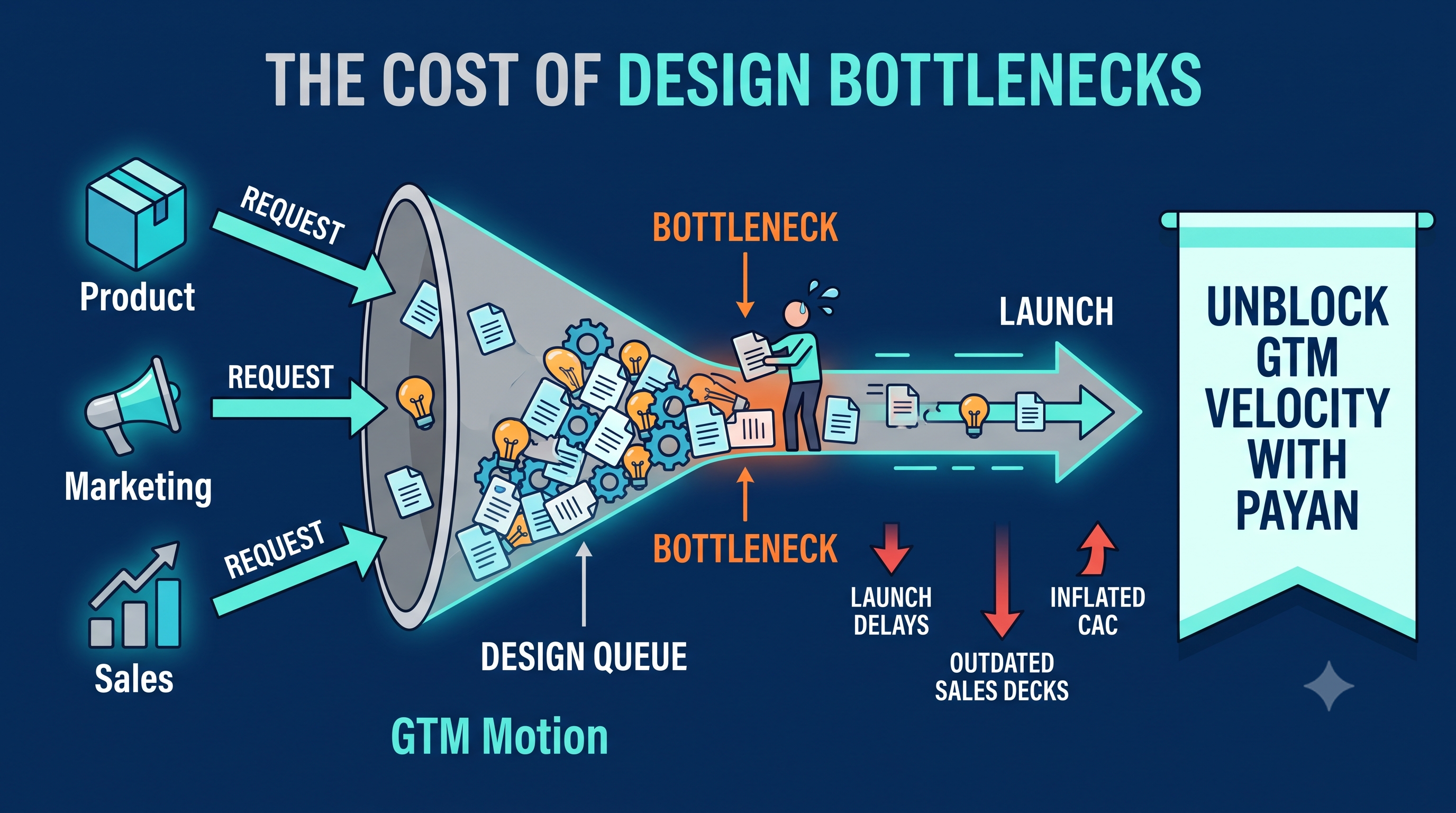
Here's why it happens. In most SaaS teams, design sits downstream of everything. Product needs UI. Marketing needs campaign assets. Sales needs decks. Every one of those requests lands on the same one or two people, usually with no shared visibility into how much is already queued. Each request feels reasonable in isolation. A landing page. A slide deck. A few ad variants. But stacked together, they turn design into the actual constraint on how fast the company can go to market, even though nobody planned for that role.
The cost of this doesn't show up as a line item, which is exactly why it's easy to miss. It shows up as a launch that ships eight days late, which means it now overlaps with the next campaign instead of getting a clean runway. It shows up as sales working a deck that's two versions behind the current positioning, because updating it fell to the bottom of the design queue. It shows up as paid campaigns going live with generic creative because the on-brand version wasn't ready, quietly inflating CAC because the ads underperform. None of these get traced back to design capacity. They get logged as a soft quarter.
The pattern GTM founders miss is that design bottlenecks compound. A campaign that slips by a week doesn't just lose a week. It pushes into the next sprint's design queue, delaying that one too, and the gap between planned launch and actual launch keeps widening every cycle. Meanwhile the team has already built the GTM plan assuming design would keep pace, so sales and marketing timelines stay locked to a calendar that design was never resourced to hit.
The usual fixes don't solve the actual constraint. Hiring a second in-house designer takes months to source and onboard, and by the time they're ramped, the launch that needed them has already happened. Pushing the roadmap out further just moves the bottleneck downstream instead of removing it. Asking the existing designer to work faster treats a capacity problem as a discipline problem, and burns out the person you need most during launch weeks.
What actually fixes it is decoupling GTM velocity from a fixed headcount. That means having design capacity that flexes with the calendar instead of design being the thing everyone else has to flex around. When a launch week needs five assets instead of the usual two, the team needs a way to absorb that surge without derailing whatever the in-house designer was already committed to. That's a structural fix, not a hiring fix, and it's usually the difference between a GTM motion that holds its own timeline and one that quietly slips every quarter.
If this pattern sounds familiar, it's worth mapping out where in your GTM calendar design actually becomes the constraint, before the next launch hits the same wall. Payan works with SaaS teams as a design partner built for exactly this kind of variable, campaign-driven demand, so launch weeks don't have to wait on a single designer's queue.