Every Campaign Waits on Design: Fixing the Slowest Step in Your GTM

Author
Every Campaign Waits on Design: Fixing the Slowest Step in Your GTM

The campaign that's ready except for the part that isn't

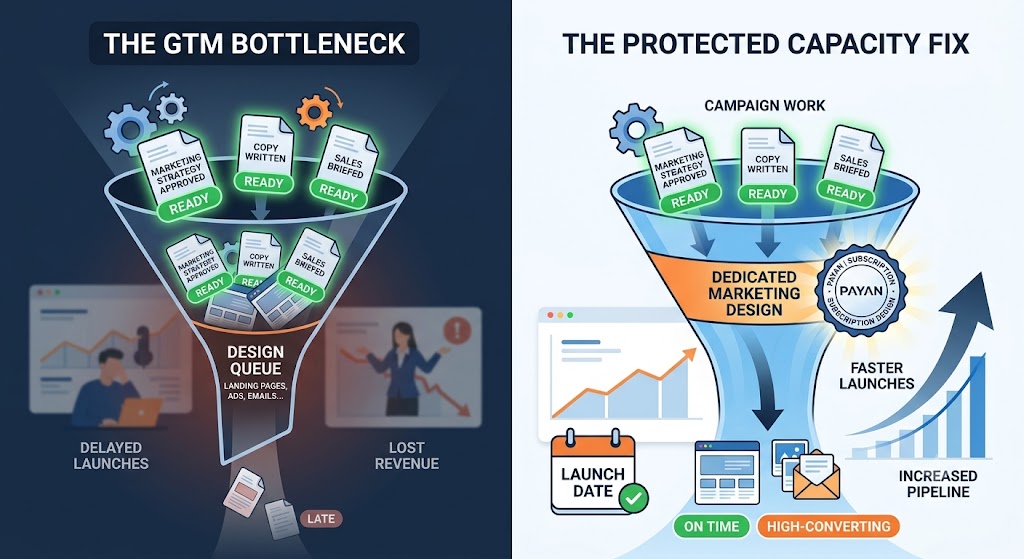
The strategy is approved. The copy is written. The media plan is loaded and the sales team has been briefed. Everything about the campaign is ready to go — except the landing page, the ad creatives, and the emails, which are sitting in a design queue behind a product release and someone else's deck.

So the launch moves. A week, maybe two. Then the next campaign hits the same wall, and the one after that. If you run marketing at a SaaS company, you've probably stopped even calling it a delay. It's just how long things take. The design step gets padded into every timeline like weather.

That quiet acceptance is worth examining, because you've normalized the slowest step in your entire go-to-market motion.
Why the queue never gets faster

The obvious explanation is that there aren't enough designers. That's true, but it's the surface. The deeper reason is structural: marketing design almost never has protected capacity.

In most SaaS companies, design capacity is shared, and shared capacity flows toward whoever's deadline is loudest. Product releases have engineering dependencies and committed dates, so product wins. Sales requests come from people with quota pressure and executive sponsors, so sales wins. Marketing campaigns are the most movable thing in the queue — because you, being reasonable, can move them. Your flexibility is exactly why you're always last.

There's a second mechanism stacked on top. Campaign work is bursty. You don't need a steady drip of assets; you need a cluster of them — page, ads, emails, social cuts — all at once, right before launch. A queue that processes requests one at a time is structurally wrong for work that arrives in clusters. Even a fast queue fails you, because you don't need one thing fast. You need seven things together.

And so the workarounds appear. Copy gets shipped in a template that undersells it. A PMM builds the landing page themselves in the website builder at 9pm. The ad runs with last quarter's creative. Each workaround feels like pragmatism in the moment. Collectively, they mean your most visible, most paid-for touchpoints are the ones getting the least design attention.

What the bottleneck actually costs

The waiting is annoying, but the waiting isn't the real cost.

Speed-to-market is. In SaaS, campaign timing is often the point — a launch riding a product release, a play against a competitor's stumble, a push timed to end-of-quarter pipeline needs. A campaign that ships two weeks late into a market moment isn't the same campaign slightly delayed. It's a weaker campaign. Momentum doesn't wait for the assets.

Conversion is the second cost, and it's better hidden. When design is scarce, campaigns launch with whatever could be produced in time — and "in time" beats "effective" every single week. The landing page goes out unpolished, converts a point or two below what it should, and that gap gets multiplied by your entire media spend. Nobody logs it as a design cost. It shows up in the dashboard as expensive pipeline, and the channel takes the blame.

The third cost is the one that compounds: your team stops proposing ambitious work. Once everyone learns that anything requiring real design takes a month, they start designing campaigns around the constraint — text-heavy, template-shaped, safe. The bottleneck stops delaying your GTM and starts shrinking it.

The reframe: it's not a queue problem, it's a capacity model problem

Most attempts to fix this fail because they optimize the queue instead of questioning it. Better briefs, a new request form, a prioritization meeting. These make the waiting more orderly. They don't make it shorter, because the underlying math hasn't changed: campaign-shaped work is competing for product-shaped capacity, and it will lose every time it matters.

The actual fix is to stop making marketing design compete. That means dedicated capacity — design bandwidth that belongs to the GTM motion and can't be pulled onto the product roadmap the week you launch.

The instinctive version of that is a hire, and eventually that's often right. But a hire takes months to land and ramp, it's a fixed cost against a bursty workload, and one person recreates the cluster problem — seven assets, one pair of hands, same crunch. Freelancers solve the burst but tax you with context: every new person has to relearn your product, your ICP, your brand system, and you become the briefing department.

This is the specific gap a subscription design partner fills for marketing teams: continuous senior capacity that holds your context between campaigns, absorbs the burst when launch week hits, and answers to your calendar rather than the product roadmap's. Not a replacement for an in-house team — a dedicated lane for the work that keeps losing the queue.

How to fix it in practice

A few moves, roughly in order.

Measure the lag before you argue about it. For your last three campaigns, note when the campaign was strategically ready and when it actually launched. That gap, in weeks, is your design bottleneck made visible. Leadership conversations about capacity go very differently when you open with "our GTM runs four weeks behind our decisions."

Separate the lanes explicitly. Whatever capacity you add — partner, hire, or both — draw the line by type of work, not by overflow. Product design stays with the product-aligned team. Campaign and conversion surfaces get their own protected lane. Overflow-based arrangements collapse back into a shared queue within a quarter.

Buy capacity that matches the shape of the work. Campaign work is bursty and varied. That argues for a model that can absorb clusters — a partner with a team behind it rather than a single pair of hands — and one you can scale down later when an in-house team grows into the lane. No long-term contract matters here for exactly that reason.

And hold the new lane to a conversion standard, not a volume standard. The goal was never more assets faster. It was campaigns that launch on time onto pages that convert. If the work is fast but doesn't move the numbers, you've upgraded the bottleneck into a treadmill.

Where Payan fits

This is the lane Payan was built to be. We work as a design partner for B2B SaaS marketing teams — senior designers who learn your product and ICP once, then handle the campaign surfaces continuously: landing pages, launch assets, conversion work, delivered with predictable async turnaround on a flat subscription, no long-term contract. If your campaigns are consistently ready before their assets are, that gap is fixable — usually faster than a hiring cycle.

Simple, ongoing design
support for fast-moving
teams.

Ongoing design requests, handled with predictable turnaround. No long-term commitment.

Interactive Design Preview