AI Design for Marketing Teams: Where It Helps and Where It Hurts

Author
AI Design for Marketing Teams: Where It Helps and Where It Hurts

AI design helps marketing teams move fast — but hurts on the pages that drive conversion. Here's how to tell which is which, and where to keep human judgment.

Introduction

Somewhere in the last year, your marketing team got a new superpower. A marketer can now type a sentence and get a landing page mockup. A campaign manager can spin up forty ad variations before lunch. The graphics that used to sit in a queue for a week now appear in minutes.

And the obvious question follows fast: if the machine can do this, why are we still waiting on design for everything?

It's a fair question. But it's the wrong one. Because AI design doesn't help or hurt marketing teams as a whole. It helps in some places and quietly hurts in others, and the teams that win are the ones who can tell the difference.
The trap: speed that doesn't always pay off

The first few weeks with AI design feel like a cheat code. Then the output starts showing up in places it shouldn't. A landing page that looks clean but converts worse than the old one. A set of social graphics that are all slightly off-brand in a way nobody can name. A pricing page that reads fine to the team and confuses every visitor who isn't already sold. The speed was real. The results weren't.

So let's break it down honestly, because there's a real line here.

Where AI design genuinely helps

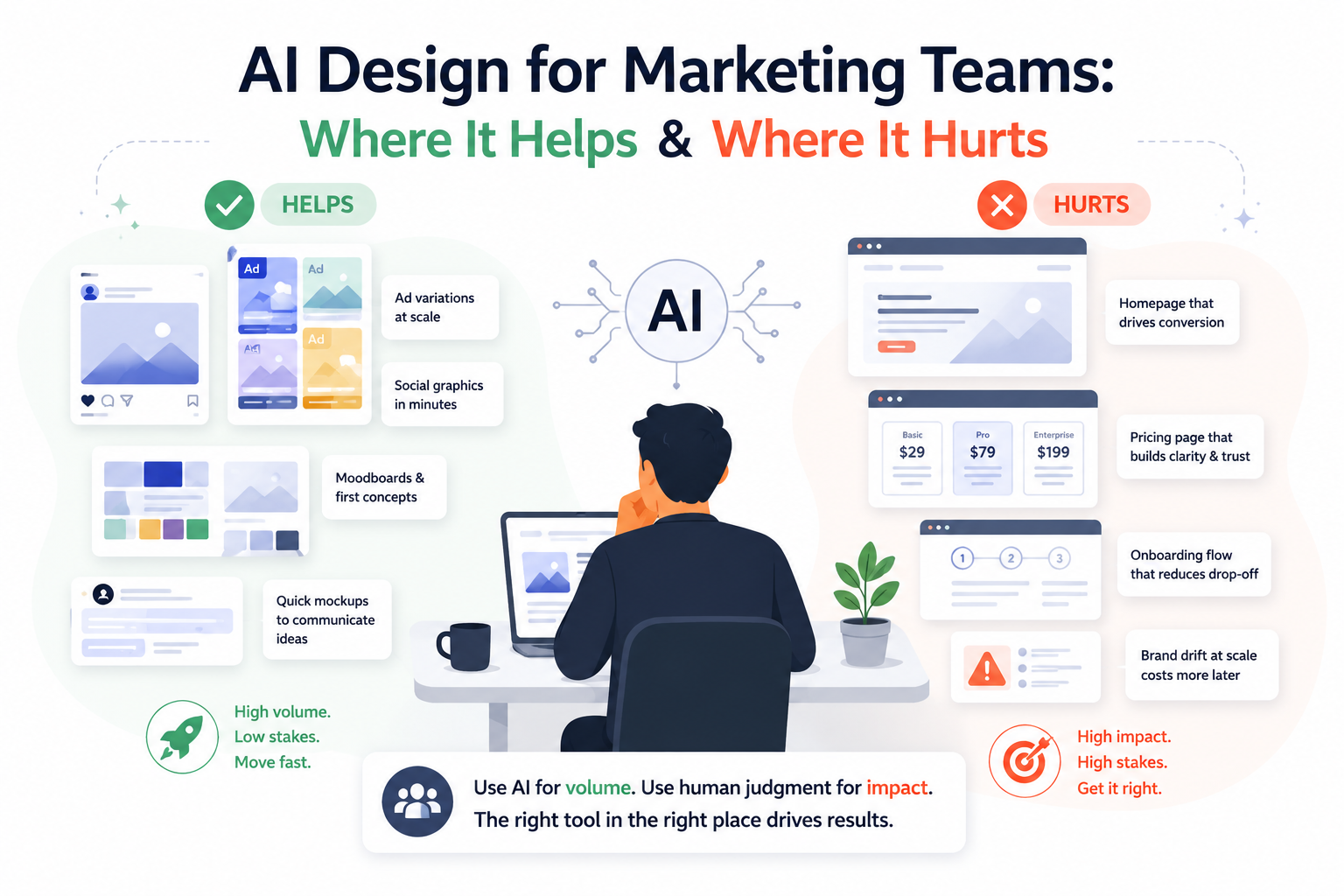
The sweet spot is volume work where the stakes per asset are low. Ad variations. Social posts. First-pass concepts you're going to throw away anyway. Moodboards to align a team before the real work starts. Quick mockups a marketer makes just to communicate an idea, so a meeting doesn't stall on "I'm picturing something like…".

In all of these, you need many options fast, and no single asset carries much weight. AI is built for exactly that. It raises your floor. It gets you unstuck. It lets people who aren't designers show what they mean instead of describing it.

Where it hurts: the pages that compound

The damage shows up at the opposite end — the small number of surfaces where one decision compounds. Your homepage. Your pricing page. Your onboarding flow. The hero section a thousand qualified visitors see before they decide whether to trust you.

On these pages, design isn't decoration. It's a sequence of choices about what a specific buyer notices first, what objection gets answered before it forms, where the eye lands when someone is half-convinced. AI doesn't know your buyer. It produces what looks like a good page, not what works on your page. And "looks right, tests wrong" is the most expensive failure mode in marketing, because nothing about it sets off an alarm. The page ships. The numbers just quietly underperform, and you don't always connect it back to the design.

The hidden cost: brand drift at scale

There's a second place it hurts that's easy to miss. One AI asset looks fine. A hundred of them, made across six tools by four people over three months, slowly pull your brand apart.

The machine doesn't hold your system in its head. It doesn't remember the spacing rule you decided on, or why your buttons read the way they do. Every generation starts from zero. The drift is invisible per asset and obvious in aggregate, and cleaning it up later costs more than doing it right would have.

The real question isn't replacement — it's placement

So here's the reframe. The question was never "should our marketing team use AI design?" It's "which surfaces can absorb AI's strengths, and which ones punish its weaknesses?" It's not a replacement decision. It's a placement decision. AI is a tool with a very specific shape, and the job is matching it to the work that fits that shape.

A simple way to sort it: when the work is high-volume and low-stakes, let AI run and don't overthink it. When the work is conversion-critical or brand-defining, keep human judgment in the loop, because that's where the cost of getting it wrong dwarfs the time you'd save. The mistake isn't using AI. The mistake is using it on the four pages that actually move revenue and treating those the same as a throwaway Instagram graphic.

What this means for your team

The underlying truth is this. AI raises the floor, not the ceiling. It makes weak design less weak and average design faster. What it doesn't do is make great design, because great design isn't a clean layout — it's a hundred small judgments about your specific buyer that the tool has no way to know. That part still belongs to someone who understands how SaaS buyers actually decide.

The goal for a marketing team isn't to use AI everywhere or to avoid it out of caution. It's to free up real design judgment for the surfaces that earn it, and let the machine handle everything that doesn't. That's where a design partner fits now — not racing AI on speed, but owning the decisions where speed was never the point. At Payan, that's the line we work along: AI for the volume, senior judgment for the pages your pipeline depends on.

Simple, ongoing design
support for fast-moving
teams.

Ongoing design requests, handled with predictable turnaround. No long-term commitment.

Interactive Design Preview